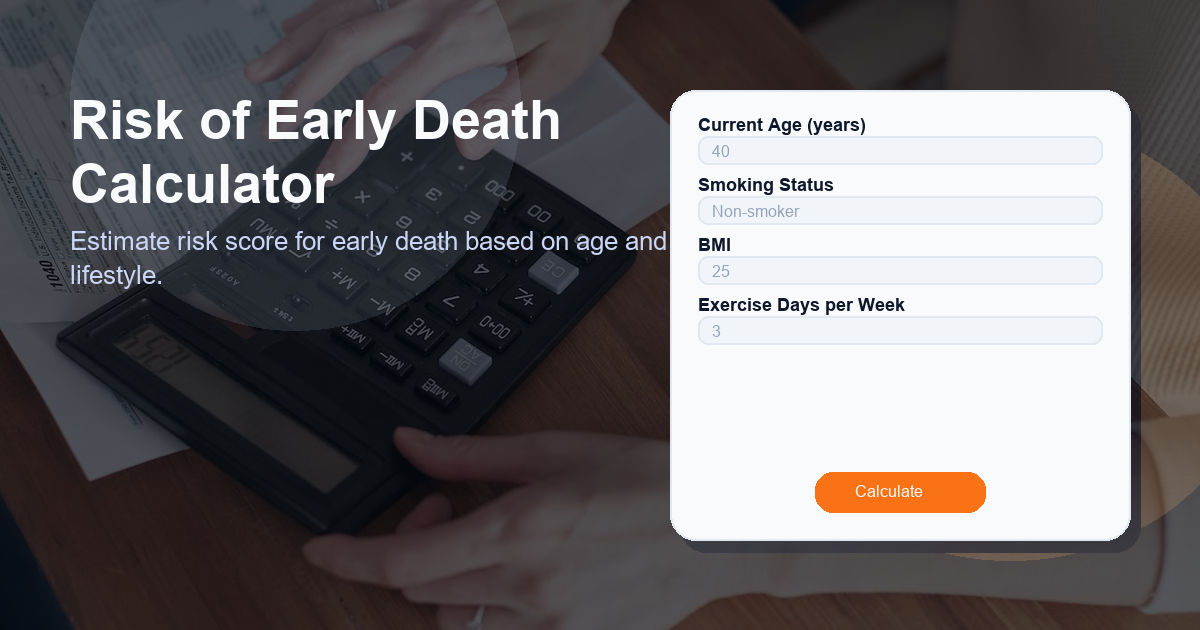
Risk of Early Death Calculator
The Risk of Early Death Calculator is a simple, evidence-informed tool designed to help adults estimate a relative risk score for early death based on a few readily available personal inputs. This article explains what the calculator does, how to use it, what the formula means, and practical ways to interpret and apply the result. Use the sections below to quickly understand the inputs, the formula, and the limitations of this screening-style tool.
What this Risk of Early Death Calculator calculator does
The Risk of Early Death Calculator generates a single numeric value labeled the Early Death Risk Score. It provides a quick snapshot of relative risk influenced by four factors:
- Current Age (years)
- Smoking Status (categorized)
- BMI (Body Mass Index)
- Exercise Days per Week (0–7)
This score is intended as a starting point for discussion and reflection—not a medical diagnosis. It can help identify lifestyle areas (smoking, physical activity, weight) that disproportionately affect long-term mortality risk and motivate healthy behavior change.
How to use the Risk of Early Death Calculator calculator
Using the calculator is straightforward. Provide accurate values for each input and follow the step-by-step instructions below to compute your Early Death Risk Score:
- Enter Current Age (years) — whole number in years.
- Select Smoking Status — choose one of the defined categories (see mapping below).
- Enter BMI — your Body Mass Index (weight in kg / height in meters squared). If you don’t know your BMI, calculate it first or use an online BMI calculator.
- Enter Exercise Days per Week — the average number of days per week you do moderate-to-vigorous exercise (0–7).
- Apply the formula below to obtain the Early Death Risk Score.
Smoking status numeric mapping used by this calculator (required to evaluate the formula):
- Non-smoker: 0
- Former smoker: 0.5
- Current smoker: 1
Important usage notes:
- Clamp sensible ranges: BMI values should be realistic (e.g., 12–60), exercise days should be between 0 and 7, and age should be a non-negative integer.
- Interpretation: The score is relative. A higher score indicates a higher modeled risk contribution from these factors.
- Not clinical: This is not a replacement for medical evaluation. See a clinician for personalized risk assessment and tests.
How the Risk of Early Death Calculator formula works
The calculator uses a compact linear formula that weights each input to generate the final Early Death Risk Score:
Formula: (smoking_status) + (bmi − 25) * 0.2 + (3 − exercise_days) * 0.5 + (current_age / 60)
Component breakdown:
- Smoking status — added as a baseline risk component. Values map to 0 (non-smoker), 0.5 (former smoker), and 1 (current smoker). Current smoking increases the score most strongly per the formula.
- (bmi − 25) * 0.2 — BMI is centered at 25 (a common reference for normal weight). For each point of BMI above 25, the term increases the score by 0.2. BMI below 25 reduces the score by the same rate.
- (3 − exercise_days) * 0.5 — exercise days are referenced to 3 days/week. If you exercise more than 3 days, this term becomes negative (lowering risk); if you exercise less, this term increases the score.
- current_age / 60 — age contribution grows slowly; for example, age 60 contributes 1.0 to the score, age 30 contributes 0.5. This models increased baseline risk with increasing age.
Example calculation 1 (low-risk profile):
- Age: 30 → 30/60 = 0.5
- Smoking: Non-smoker → 0
- BMI: 22 → (22 − 25) * 0.2 = −0.6
- Exercise: 5 days → (3 − 5) * 0.5 = −1.0
- Score = 0 + (−0.6) + (−1.0) + 0.5 = −1.1 (a lower relative risk score)
Example calculation 2 (higher-risk profile):
- Age: 55 → 55/60 ≈ 0.917
- Smoking: Current smoker → 1
- BMI: 30 → (30 − 25) * 0.2 = 1.0
- Exercise: 0 days → (3 − 0) * 0.5 = 1.5
- Score = 1 + 1.0 + 1.5 + 0.917 ≈ 4.417 (a substantially higher relative risk score)
How to interpret the numeric score:
- Scores below ~1.0 — generally lower modeled risk from the included lifestyle factors.
- Scores ~1.0–2.0 — moderate relative risk; consider targeted lifestyle changes.
- Scores above ~2.0 — higher modeled risk; stronger priority for clinical check-ups and lifestyle interventions.
These thresholds are heuristic and intended for practical guidance only.
Use cases for the Risk of Early Death Calculator
The Risk of Early Death Calculator is useful in several contexts:
- Personal health awareness: Quickly see how changes to smoking, exercise, or BMI could influence your relative risk score.
- Behavioral motivation: Demonstrate the potential benefit of quitting smoking, losing weight, or increasing weekly exercise days.
- Population health education: Use in public health materials or workshops to show the combined effect of lifestyle items on long-term risk.
- Pre-visit preparation: Bring your score to a primary care visit to discuss focused risk-reduction strategies with a clinician.
Examples of practical actions triggered by a higher risk score:
- Talk to a healthcare provider about smoking cessation programs and medications.
- Start a supervised weight-loss plan if BMI is elevated.
- Gradually increase physical activity to at least 3–5 days per week of moderate exercise.
- Schedule preventive screenings appropriate for your age and health status.
Other factors to consider when calculating x
“x” in this heading refers to the broader set of variables that influence actual mortality risk beyond what the calculator includes. Important additional factors include:
- Medical conditions: Chronic diseases (diabetes, heart disease, chronic lung disease, cancer) strongly modify risk and are not included in the simple formula.
- Family history: Genetic predisposition to early cardiovascular disease or cancer can alter absolute risk.
- Socioeconomic and environmental factors: Access to healthcare, occupational exposures, air quality, and stress levels affect long-term outcomes.
- Diet and alcohol: Nutritional quality and alcohol consumption are major contributors to mortality risk.
- Mental health and sleep: Depression, anxiety, and chronic sleep deprivation affect longevity and behavior patterns.
Because the Risk of Early Death Calculator intentionally focuses on a few modifiable widgets (age, smoking, BMI, exercise), it should be used as a complementary tool. For a fuller clinical risk assessment, include laboratory data, medical history, and a professional evaluation.
FAQ
Is the Risk of Early Death Calculator a medical test?
No. The calculator provides a simple, return-of-value score based on lifestyle and age. It is not a diagnostic or clinical test. Use it as an educational tool and consult a medical professional for formal risk assessment and testing.
What does the Early Death Risk Score represent?
The Early Death Risk Score is a relative composite score; higher values indicate a higher modeled contribution of the included factors to mortality risk. It is not an absolute probability of death.
Can I use this calculator for children or teenagers?
This calculator is intended for adults. BMI interpretation and age-dependent risks differ for children and adolescents; consult pediatric growth charts and a pediatrician for younger individuals.
How should I change my lifestyle if my score is high?
Prioritize smoking cessation, increase weekly exercise, and aim for gradual, sustainable weight loss if BMI is elevated. Discuss personalized steps with a healthcare provider. Small, consistent changes often yield measurable risk reduction over time.
Can the formula be adjusted for different populations?
Yes. The formula uses simple linear weights and can be recalibrated for specific populations or datasets. However, any recalibration should be guided by epidemiological evidence and validation against health outcomes.
Final reminder: The Risk of Early Death Calculator is a helpful, quick tool to highlight lifestyle impacts but should not replace clinical judgment. Use the score to inform conversations with healthcare providers and to motivate concrete, evidence-based health improvements.