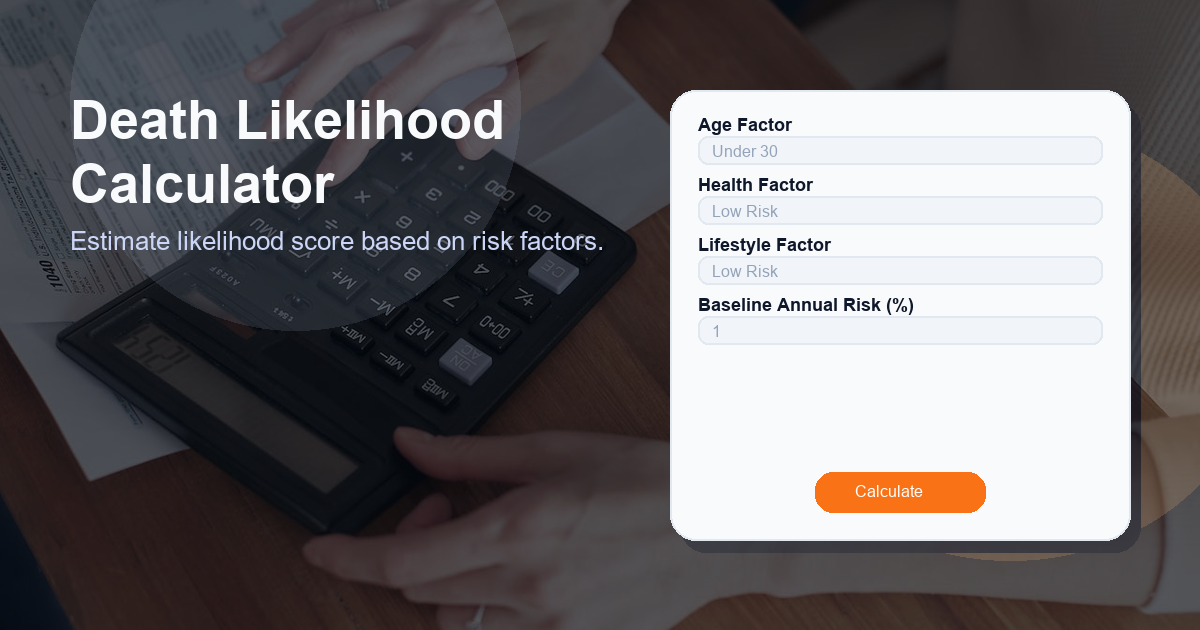
Death Likelihood Calculator
Description: Estimate likelihood score based on risk factors using the Death Likelihood Calculator. This tool provides a simple, transparent way to combine a baseline annual risk with multiplier factors for age, health, and lifestyle to produce a single Likelihood Score.
What this Death Likelihood Calculator calculator does
The Death Likelihood Calculator is a straightforward risk-estimation tool that multiplies a known or assumed baseline annual risk by three adjustable factors: Age Factor, Health Factor, and Lifestyle Factor. The result is a single score labeled the Likelihood Score that represents a relative percentage estimate of annual mortality risk given the inputs.
This calculator can help you:
- Quantify relative changes in risk when one or more modifiable factors change.
- Compare scenarios (for example, current lifestyle vs improved lifestyle, or different health intervention outcomes).
- Understand driver effects by isolating age, health, and lifestyle multipliers.
Important: This tool provides an estimate for informational and planning purposes only. It is not a medical diagnosis or definitive prediction. Always consult qualified health professionals for personal medical advice. If you are feeling distressed or in immediate danger, seek emergency help.
How to use the Death Likelihood Calculator calculator
Using the Death Likelihood Calculator involves four inputs and one simple multiplication formula. Follow these steps to get a result:
- Enter Baseline Annual Risk (%): Start with a baseline annual mortality risk expressed as a percentage. This could be an age-group average, published epidemiological rate, or an insurer’s baseline. Example: 0.5% per year.
- Choose an Age Factor: Select or input a multiplier representing how age increases or decreases risk relative to the baseline. Example: 1.5 for older adults, 0.8 for younger adults.
- Choose a Health Factor: Provide a multiplier reflecting medical conditions, overall health status, comorbidities, or frailty. Example: 1.2 for chronic disease, 0.9 for excellent health.
- Choose a Lifestyle Factor: Input a multiplier representing behaviors such as smoking, alcohol use, exercise, diet, and safety practices. Example: 1.6 for high-risk lifestyle, 0.85 for healthy behaviors.
- Calculate: The calculator applies the formula and returns the Likelihood Score, an annual percentage estimate.
Inputs (explicit):
- Age Factor
- Health Factor
- Lifestyle Factor
- Baseline Annual Risk (%)
Result label: Likelihood Score
Example: Baseline Annual Risk = 0.5% (0.5). Age Factor = 1.5. Health Factor = 1.2. Lifestyle Factor = 1.6. Plug into the formula to get a result (see formula section below).
How the Death Likelihood Calculator formula works
The formula used by this calculator is intentionally simple and transparent:
Formula: baseline_risk * age_factor * health_factor * lifestyle_factor
How to interpret the formula:
- Baseline risk should be entered as a percentage (for example, 0.5% can be entered as 0.5 or 0.005 depending on the calculator UI convention—verify your tool). In this article we assume percentage input like 0.5 for 0.5%.
- Multipliers (factors) are dimensionless numbers that scale the baseline. Values greater than 1 increase the risk, values less than 1 decrease it, and 1 means no change relative to the baseline.
- Multiplicative approach reflects the idea that risk exposures often interact, compounding one another rather than adding linearly.
Example calculation (percentage-mode baseline):
- Baseline Annual Risk = 0.5%
- Age Factor = 1.5
- Health Factor = 1.2
- Lifestyle Factor = 1.6
- Likelihood Score = 0.5 * 1.5 * 1.2 * 1.6 = 1.44%
Interpreting the Likelihood Score: In the example above, the calculated Likelihood Score of 1.44% means an estimated 1.44% annual mortality probability under the specified assumptions. This is an estimate, not a certainty.
Use cases for the Death Likelihood Calculator
The Death Likelihood Calculator can be applied in a variety of contexts where a transparent, quick estimate helps inform decisions. Key use cases include:
- Personal health planning: Individuals evaluating how lifestyle changes may reduce annual risk (e.g., quitting smoking or improving diet).
- Preliminary research: Early-stage academic or public-health projects that need a simple model to explore scenarios before deploying complex models.
- Insurance and risk assessment: Insurers or underwriters performing high-level sensitivity checks or scenario comparisons (not a substitute for actuarial models).
- Healthcare communication: Clinicians and educators illustrating relative risk impacts of age, comorbidity, and behavior in patient discussions.
- Policy planning: Public health planners modeling population-level impacts when combining baseline rates with demographic and behavioral multipliers.
Benefits of this tool include its speed, transparency, and flexibility: you can test many “what-if” scenarios by adjusting single multipliers and immediately seeing the effect on the Likelihood Score.
Other factors to consider when calculating death likelihood
While the Death Likelihood Calculator captures three fundamental multipliers, several important factors are not encoded in a simple multiplicative model. Consider the following when interpreting results:
- Genetics and family history: Inherited conditions can significantly alter baseline risks but are difficult to translate into a single multiplier without clinical genetic assessment.
- Socioeconomic status: Income, education, and neighborhood safety influence access to care, nutrition, and environmental exposures.
- Healthcare access and quality: Timely diagnosis, preventive care, and treatment availability can reduce risk independently of personal behavior.
- Mental health and stress: Chronic stress, depression, and substance use can increase mortality risk via physiological and behavioral pathways.
- Acute events and randomness: Accidents, infections, and sudden events can dominate annual outcomes and are inherently stochastic.
- Interaction effects: Some factors interact nonlinearly (for example, certain chronic diseases plus risky lifestyle behaviors may multiply risk more than a simple factor suggests).
Because of these complexities, use the Death Likelihood Calculator as a starting point for conversations and planning, not as definitive proof of individual prognosis. Combine results with professional medical evaluation, epidemiological data, and contextual judgment.
FAQ
1. What is the meaning of the Likelihood Score?
The Likelihood Score is an estimated annual mortality percentage derived from multiplying a baseline annual risk by the age, health, and lifestyle factors you provide. It represents a relative, not absolute, prediction and should be interpreted with caution.
2. How should I choose the multipliers for age, health, and lifestyle?
Multipliers should reflect relative risk compared to the baseline. Use published epidemiological data, clinical judgment, or insurer assumptions when available. In absence of data, choose conservative values (e.g., 0.8–1.5 range) and perform sensitivity checks.
3. Can this calculator replace medical advice or actuarial models?
No. This calculator is a simplified estimator for informational use. It cannot replace individualized medical advice from a clinician or comprehensive actuarial modeling used by insurance professionals.
4. Is it safe to use the Death Likelihood Calculator for planning?
Yes, as long as you recognize its limitations. It is useful for scenario comparison and planning, but you should supplement it with professional guidance and real-world data for critical decisions.
5. What if the Likelihood Score seems unexpectedly high or low?
Review your inputs: check that the baseline risk is in the correct unit (percentage) and that multipliers are reasonable. Consider missing factors (e.g., genetics, access to care) and run alternative scenarios to understand sensitivity.
Final note: The Death Likelihood Calculator provides a transparent, easy-to-understand way to combine a baseline risk with age, health, and lifestyle multipliers. Use it responsibly: for education, scenario planning, and discussion, and always consult professionals for personal health decisions.