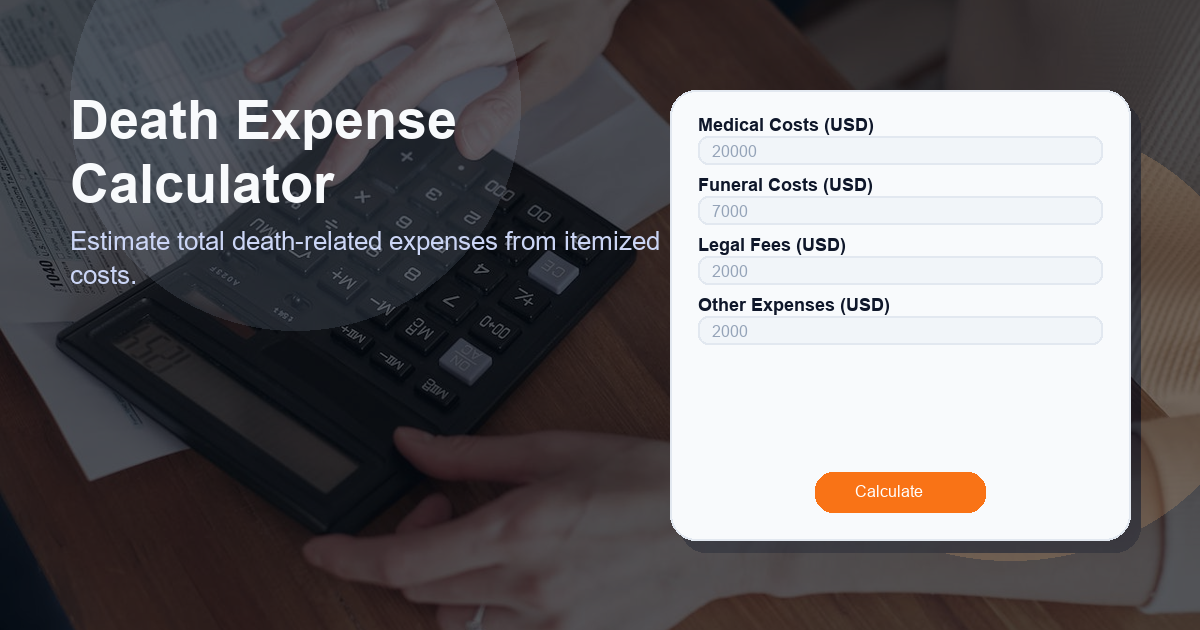
Death Expense Calculator
Description: Estimate total death-related expenses from itemized costs. Use the Death Expense Calculator to quickly add up common end-of-life costs and get a clear figure labeled Total Death Expenses.
What this Death Expense Calculator does
The Death Expense Calculator is a simple, focused tool designed to help individuals and families estimate the immediate monetary costs associated with the passing of a loved one. It aggregates the most common categories of out-of-pocket spending so you can plan, budget, or evaluate the adequacy of existing insurance and savings.
This calculator accepts four primary inputs:
- Medical Costs (USD) — final hospital bills, hospice care, medication, and related end-of-life medical expenses.
- Funeral Costs (USD) — funeral home services, burial or cremation, casket or urn, flowers, obituary notices, and any ceremony costs.
- Legal Fees (USD) — probate, will execution, executor fees, attorney fees for settling the estate, and other legal filings.
- Other Expenses (USD) — outstanding bills, transportation, travel for family members, taxes, and any additional one-off expenses.
After entering each itemized cost, the calculator applies a straightforward addition formula and returns the Total Death Expenses.
How to use the Death Expense Calculator
Using the Death Expense Calculator is quick and straightforward. Follow these steps to get an accurate estimate:
- Gather recent bills and estimates for medical, funeral, legal, and other costs.
- Enter each amount in USD into the corresponding input field below.
- Click the Calculate button to display the Total Death Expenses.
- Review the result and consider rounding up or adding a contingency buffer (recommended 10–20%).
Result: Total Death Expenses: $0.00
How the Death Expense Calculator formula works
The formula behind the Death Expense Calculator is intentionally simple and transparent so you can verify and trust the result. The formula used:
medical_costs + funeral_costs + legal_fees + other_expenses
Each element is an input field representing an expense category. The calculator performs a straightforward sum of these four inputs and produces the Total Death Expenses. Here’s how each term contributes:
- medical_costs: Final medical invoices, hospice charges, and any unpaid health care costs due to end-of-life treatment.
- funeral_costs: Expenses for memorial services, burial or cremation, caskets, venues, and associated goods/services.
- legal_fees: Costs for probate, lawyer consultations, estate administration, and required filings.
- other_expenses: Miscellaneous costs such as unpaid utilities, debt settlements, transportation, catering for gatherings, or taxes.
Example calculation: If you enter Medical = $4,200.00, Funeral = $7,500.00, Legal = $1,200.00, Other = $800.00, the calculator computes:
Total Death Expenses = 4200 + 7500 + 1200 + 800 = $13,700.00
Use cases for the Death Expense Calculator
The Death Expense Calculator is useful in multiple scenarios. It provides a simple first step for financial planning and helps families and professionals make informed decisions:
- Estate planning: Determine whether existing life insurance and savings will cover immediate end-of-life expenses.
- Insurance needs assessment: Evaluate whether the beneficiary payouts are sufficient to avoid out-of-pocket burdens.
- Pre-planning funerals: Compare pre-paid funeral plans against likely costs to decide whether prepayment is worthwhile.
- Financial counseling: Advisors can use the calculator during client consultations to produce quick estimates.
- Emergency budgeting: When unexpected costs arise, this tool helps tally immediate liabilities to prioritize payments.
Other factors to consider when calculating death expenses
While the Death Expense Calculator captures the primary categories, real-world planning should account for additional variables that might increase or reduce the final burden:
- Inflation and regional cost differences: Funeral and legal costs vary by location and time—adjust estimates accordingly.
- Outstanding debts and mortgages: Some debts may need to be settled by the estate before distributions; these are separate but related to total financial impact.
- Taxes and estate duties: Estate or inheritance taxes vary by jurisdiction and may not be included in the four basic inputs; consult a tax advisor.
- Insurance processing delays: Timing of life insurance payouts can affect who pays initial expenses; you may need short-term liquidity.
- Pre-paid arrangements and waivers: If funeral services are pre-paid, subtract those amounts from estimated funeral costs to avoid double-counting.
- Non-monetary costs: Time, emotional labor, and logistical effort aren’t captured by the calculator but are important when planning.
FAQ
Q: What exactly does the Death Expense Calculator include?
A: The calculator includes four input categories—Medical Costs, Funeral Costs, Legal Fees, and Other Expenses—and sums them to provide the Total Death Expenses. It is intended as an estimate for immediate, out-of-pocket costs.
Q: Can I include estate taxes or outstanding loans in this calculator?
A: You can include them as part of Other Expenses, but estate taxes and debts may require separate, more detailed calculations depending on local laws. For precise tax treatment, consult a tax professional.
Q: Is the result legally binding or an official estimate?
A: No. The output is an estimate to aid planning. It is not a legal or financial statement. For binding estimates, obtain written quotes from service providers and consult legal counsel.
Q: Should I add a contingency to the Total Death Expenses?
A: Yes. It’s common to add a 10–20% contingency to account for unexpected or underestimated costs. This helps avoid shortfalls if bills are higher than initial estimates.
Q: How often should I update my inputs?
A: Revisit your estimates annually or after major life events (e.g., relocation, changes in health, or changes in local funeral costs). Keeping figures current ensures your planning remains realistic.
Use the Death Expense Calculator as a practical starting point. Combine it with detailed quotes, insurance reviews, and professional advice for comprehensive end-of-life financial planning.